
To search the Library catalogue use the catalogue search page.


This exhibition, which includes Bibles in many languages, is on display in the first gallery of the library. In the second gallery, a selection of the books from the medical exhibition 'Hippocrates Revived' is presented (see below for description).
The text of the Archbishop's speech may be found below.
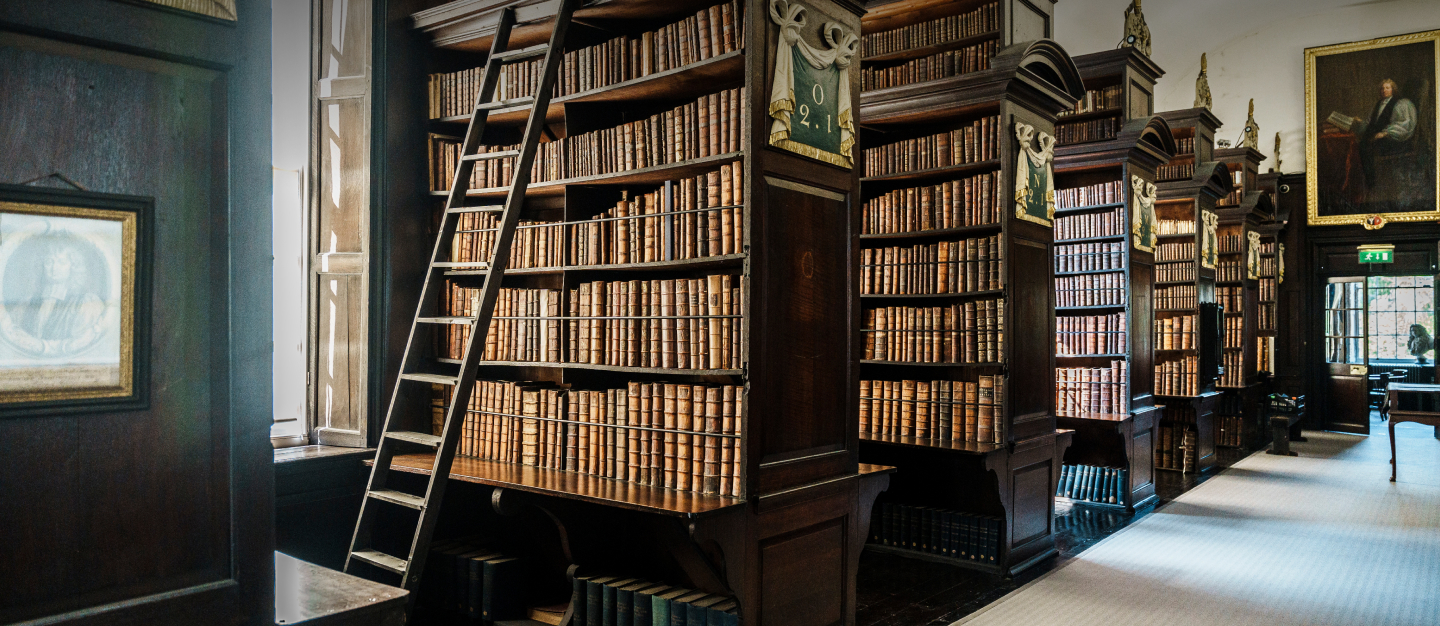
Presuming to speak at the opening of an Exhibition of Bibles in Marsh's Library is indeed just that, a presumption. Narcissus Marsh, successively Provost of Trinity College and Archbishop of Dublin, built a public library in 1701. It remains such a library with public access to this day. We are in it this evening. The genesis of this library lies not only in the generosity of Narcissus Marsh himself but also in his foresight in purchasing the library of Bishop Edward Stillingfleet. The library was also the recipient of books from Dr Elias Bouhereau, the Huguenot first librarian, and from Bishop Stearne of Clogher. All of this went to make up what is an architectural jewel and also the locus of a collection of printed books which is the pride of St Patrick's Close and of the whole of Ireland - and the envy of any from elsewhere who have seen it.
All of us gathered this evening are delighted by the prospect of the FIAT LUX Exhibition, compiled with that characteristic care and imagination by Muriel McCarthy and Ann Simmons. It is offered in the spirit of Archbishop Marsh - public access to things which matter - and celebrates in a thoroughly international way the 400th anniversary of the King James Bible. During this year 2011 people across Ireland have sought to offer such celebration in a range of different ways. Marsh's has done the KJV proud by offering us from within its treasure-store Bibles which chronicle the range and diversity of printed word in the service of the Word of God.
In the Christian tradition we celebrate every Christmas the Word made flesh. Here this evening we celebrate the Word of God made human in a number of other ways, by its being made book with care and affection and offered to others to read and interpret for themselves. Each volume has a context, a life and, dare I say it, a personality which comes from that context. It may be polemical, it may be revolutionary, it may be institutional or, indeed, individual. Whatever the specifics, it has a story to tell as well as telling the story of God's interaction with the human race as history evolves from age to age.
If you make your way on foot down the Mount of Olives in Jerusalem, you will pass the Pater Noster Church. You may even decide to enter it. There, right around the courtyard you will see the same prayer: Our Father... in mosaic, written in hundreds of languages worldwide. Something of this spirit pervades tonight's Exhibition. There are Bibles in English, Polyglot Bibles representing Hebrew, Greek, Latin, Chaldee, Aramaic, Syriac, Ethiopic, Arabic, Persian and the Samaritan Pentateuch. A number of these languages emerges again in the Bibles on display in other parts of the Exhibition. It includes works in Irish, French, German, Italian, Spanish, Dutch, Yiddish, Ojibwa, Rarotongan and Malay. In these last three instances, Archbishop Marsh is assisted and supplemented by his nineteenth-century successor Archbishop Whately.
The significance of this Exhibition is manifold. One way, of course, is its sheer breadth and imagination. Another is the significance and importance given to Bibles themselves when they were among the very few publicly heard books of their time. The revolution at the heart of the KJV is surely its making readily accessible the content of the Bible in a language which people could then understand. But there are other causes to stop and be amazed. In the midst of the grand sweep of regal and aristocratic patronage, take the case of Anthony Purver. A Quaker preacher of the eighteenth century, Purver was self-taught in languages and ideas, responding to a divine prompting to translate the scriptures. Single-handedly, over thirty years, he laboured - never to find a publisher. His manuscript was finally published by Dr John Fothergill at his own expense. Is Purver a failure or an inspiration? The KJV held the ring in his century and he simply could not break into the market.
The Exhibition contains both a manuscript and a printed version of Bishop Bedell's Old Testament in Irish along with the Irish New Testament of William Daniel, archbishop of Tuam. Daniel's intention was to present it to Queen Elizabeth I after its completion in February 1603 but we cannot be sure she saw it, since she died in March 1603. However, opportunism as well as erudition can form part of the Irish intellectual armoury then as now; since the sheets, apparently, had not been bound, Daniel was able to insert in English a dedication to the new King James I and thereby to rescue scholarship from the jaws of bad timing.
Amsterdam is pivotal for understanding the development and printing of what we take for granted as the Bible. The Ferrara Bible in Spanish was produced in Amsterdam in 1553 for Sephardic Jews. It became the basis for the first whole Bible in Spanish printed in Basel in 1569. Revised by Cipriano de Valera, and again printed in Amsterdam in 1602, it became the Spanish equivalent of the Authorized Version. And, of course, Marsh's has a copy. There are many more tales to tell but, at this point in the evening, I shall leave you to discover them for yourselves with the aid of the excellent Catalogue.
I wish to end with another tale of Jerusalem, which holds together something of the life of controversy which that short word: Bible - and what any of us makes it mean - can generate. The Hebrew Bible of 1635 to be found in this Exhibition was printed by Henricus Laurentius in association with Menasseh ben Israel in Amsterdam. Most of the religious literature in Spanish and Portugese intended for Sephardi communities worldwide was composed and printed in Amsterdam. In the Museum of Israel today you find transplanted and reconstructed the Synagogue from Surunam, Brazil dated 1732. Along with the wonderful mahogany furniture, there is sand on the floor - why? To remind this community of the ancient wanderings of 40 years in the desert, of course, but also for another reason. Members of his Sephardi community were descendants of Jews who had been forced to convert to Christianity, having come to South America from Holland as traders. The sand was a constant reminder of their shame at enforced conversion and capitulation. They had in time returned to Judaism. Footprints in the sand are eventually blown into anonymity by the wind. In this way, the sand reminds them of their desire not to be noticed adversely by God for what they were forced to do. President McAleese has often reminded us that in Ireland we have a shared history but have no shared memory. Here are people who share, but conceal, a memory of themselves. I just wonder if the religious texts of this community came from the same publishing house as our Hebrew Bible in this evening's Exhibition.
The Bible may indeed make a community. It may also dismantle a community. As we celebrate in 2011 the publication of the KJV in 1611, let us remember that somewhere in that book we are reminded that the Word of God is sharper than a two-edged sword. It continues to cut many ways.
+ Michael Jackson, archbishop of Dublin 28th June 2011
The exhibition starts with the ancient Greek medical writers Hippocrates and Galen. The majority of the books deal with the famous doctors and medical problems of the 16th and 17th centuries. These include William Harvey's discovery on the circulation of the blood, Robert Boyle's Memoirs for the natural history of humane blood, and Richard Lower's exciting innovations and experiments in cardiology. There is an account by Jean Baptiste Denis, physician to Louis XIV, who performed the first recorded transfusion of blood into a human being on 15 June 1667.
The case entitled ‘The Black Bile' contains a book by Johannes Wier, De praestigiis daemonum, which caused a storm of criticism in 1563 as he suggested witches' confessions were delusions. Robert Burton's Anatomy of Melancholy, with its engraved title page.
Under the section entitled ‘The Subtle Knife' we have Wilhelm Fabricius (Hildanus), called the father of German surgery, who was the first to use magnets to extract iron slivers from the eye and the first to operate successfully for gallstones. Also here is Francois Tolet, master surgeon from Paris, who wrote a treatise in 1686 on lithotomy or the extraction of the stone from the bladder. The illustrations show in startling detail the operating methods.
The case on Irish doctors or those operating in Ireland includes works by 17th century physicians Edmund O'Meara and Bernard Connor . In the 18th century the philosopher George Berkeley wrote about tar water as a cure and John Rutty wrote about the qualities of Irish mineral waters. A book by Charles Allen deals with the anatomy of the teeth, and the replacement of missing teeth with transplants or substitutes. Printed in the 1680s, it is the earliest known book in English devoted exclusively to the treatment of the teeth.
The section on maternity contains a book by the French midwife Louyse Bourgeois, who wrote the first book on obstetrics by a midwife, and a work by François Mauriceau, one of the leading obstetricians in France. Mauriceau introduced the practice of delivering his patients in bed instead of in the obstetrical chair and was the first to describe tubal pregnancy. The illustrations show difficult birth presentations.
One outstanding book in the Anatomy section is Bidloo's Anatomia humani corporis, printed in 1685,which contains magnificent fine copperplate engravings. There are sections on chemistry and on diseases of the eye and ear. The case entitled ‘Frauds and Freaks' contains books on monsters and quacks, and includes a pamphlet printed anonymously in Dublin in 1725 suggesting the punishment of castration for quack doctors and apothecaries.
The Exhibition is open to the public during the Library's normal working hours: Mon, Wed, Thurs, Fri.: 9.30-1.00 and 2.00-5.00; Sat. 10.00-1.00. (Closed Tues. & Sun.)